Building intelligence for organizations
Building intelligence that stays with the building.
Harmelo turns fragmented building history into operating intelligence: what you own, what is known about it, what changed and what needs attention or funding next, kept useful for every party who touches the building.
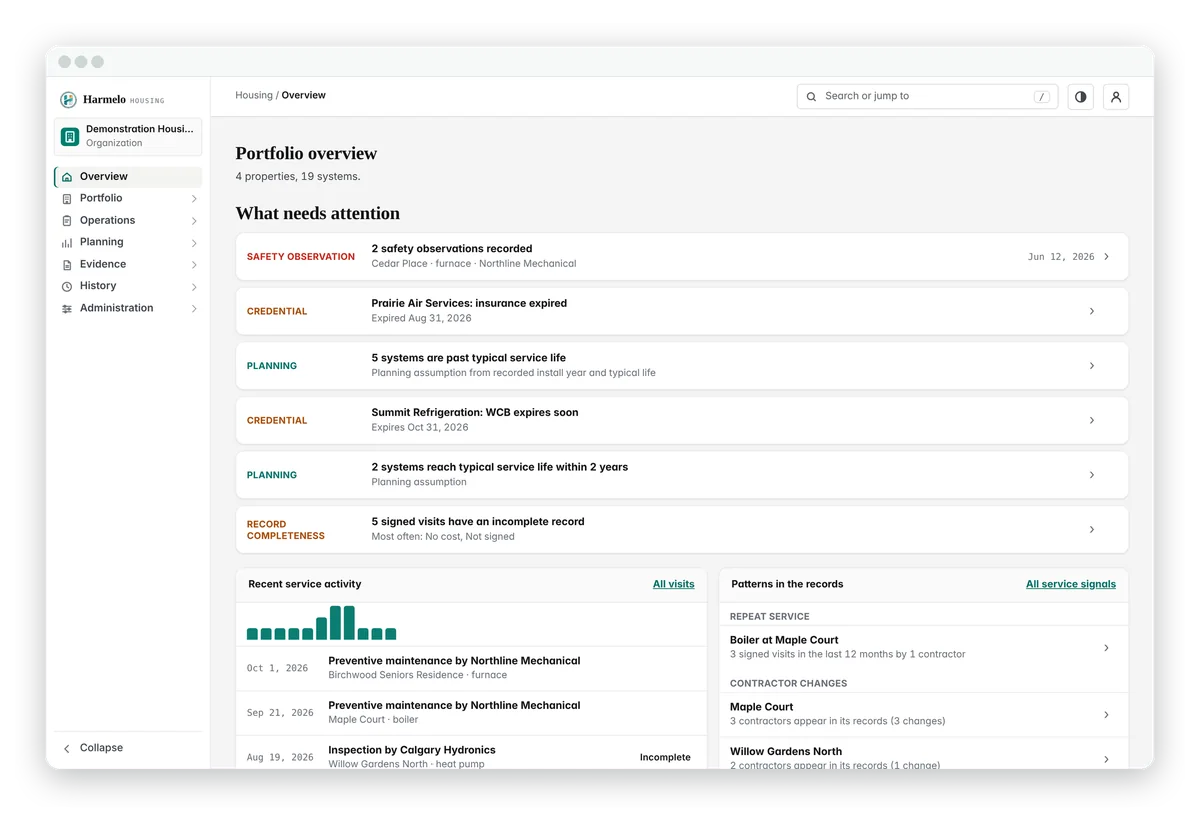
- What you ownBuildings, equipment and identity, on one record.
- What was doneSigned visits and documents, by whom and when.
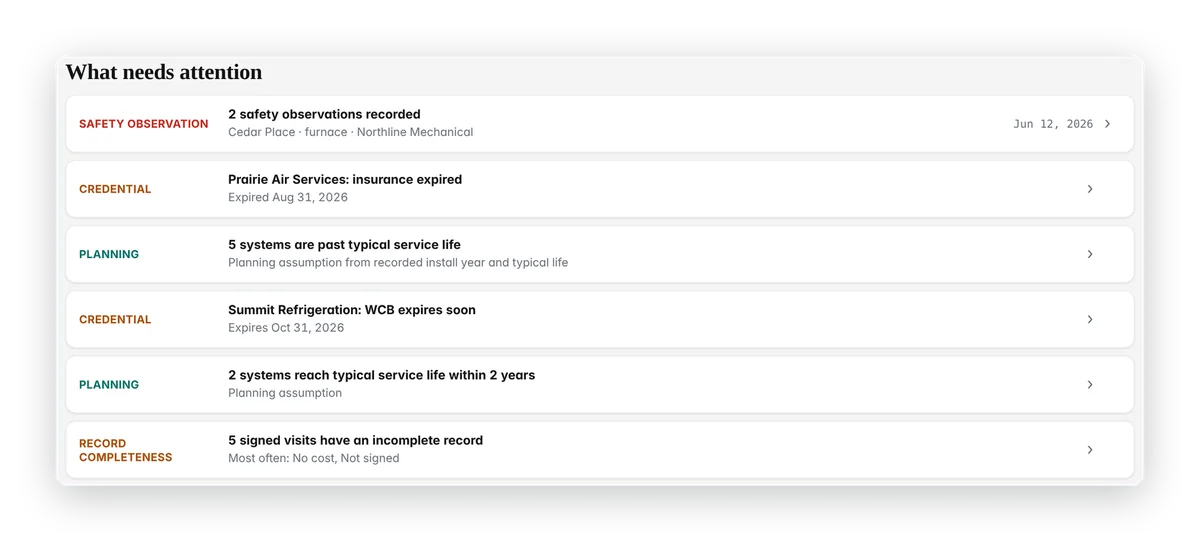
- What needs attentionEach item with its reason and its evidence.
- What is comingReplacement and reserve planning from the record.
The problem
Your organization should not have to pay twice for the same building knowledge.
The inspection was completed, the contractor was paid and the employee knew the building. Then the report was filed, the contract changed and the person left. The next decision starts from a search through inboxes, spreadsheets and memory.
- Records scatter across contractors, software and people who leave.
- Service history stays with the vendor, not with the equipment.
- Capital plans are rebuilt from memory every budget cycle.
A new operating model
From scattered history, to a governed record, to intelligence.
The continuing record is the foundation. What changes is what you can do with it.
Capture the work where it happens
Technicians file each visit against the equipment: checklist, readings, photos, parts, findings and the sign-offs the template requires.
Keep one governed record
Every fact carries its source, its date and who recorded it. Evidence is reviewed before it changes the record, and gaps are named, not hidden.
Act on what it shows
What needs attention, what may need funding, where evidence is thin, and what to hand over when a building, a contractor or a manager changes.
Every job adds to what the building knows.
One record per building: what is installed, what is documented, what work was done and by whom, the evidence behind it, and what is still unknown. Every visit leaves the next one better informed.
Missing information is shown as missing and is never treated as a defect. The record does not diagnose equipment, predict failure or replace a qualified professional's judgment.
7 of 7 entries on the record
- InstalledModel, serial and installation details recorded when the unit goes in.
- Documentation attachedInvoice, manual, warranty papers and photos kept with the unit.
- Service visit recordedChecklist, readings and photos filed by the technician who did the work.
- Observation addedA finding noted at the equipment, with its evidence beside it.
- Follow-up completedThe recommendation and what was decided, recorded against the same unit.
- Equipment replacedThe new unit starts its own record. The old unit's history stays with the building.
- History preservedStaff, contractors or owners change. The record stays with the building.
Product proof
The real workspace, not an illustration.
Current screens from Harmelo, opened in a fictional demonstration organization. Choose a view.
Building record
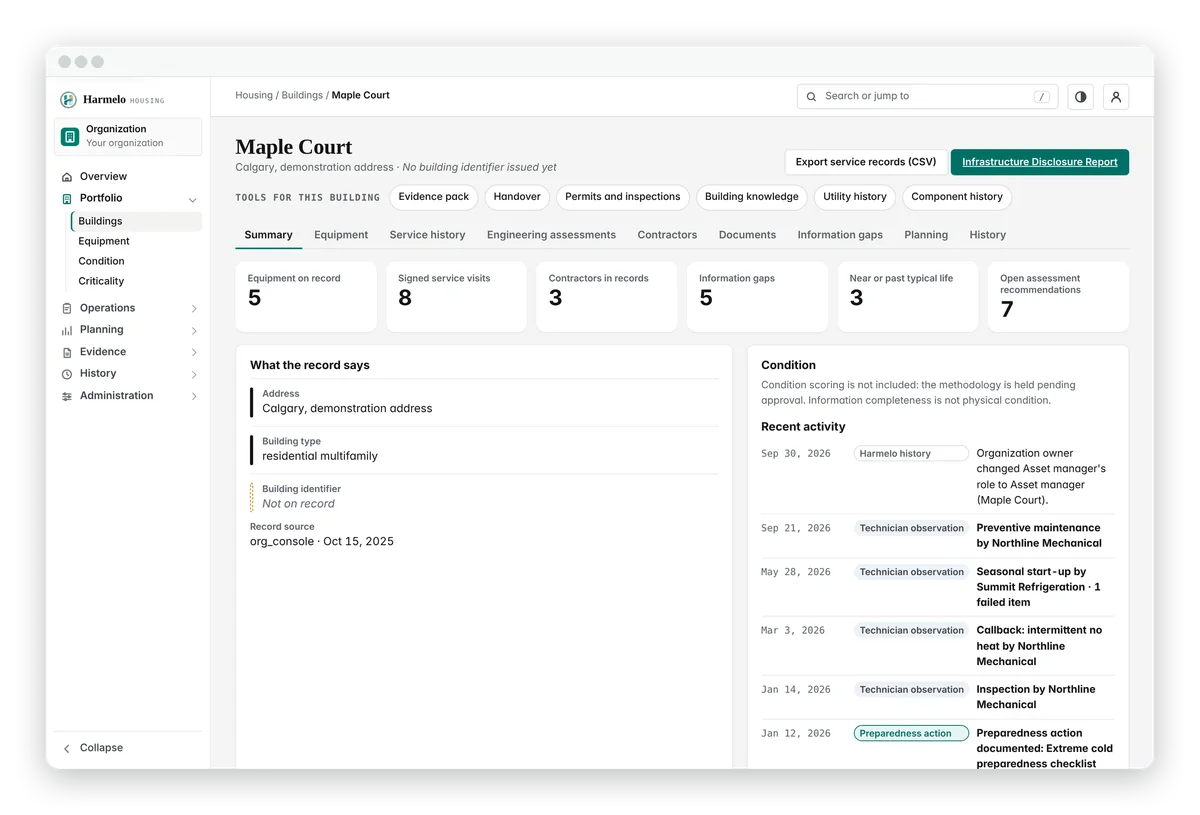
Why it matters: the next person starts from the history, not from nothing.
Equipment history
Why it matters: service history stays with the equipment when contractors or staff change.
Field to office
Why it matters: field information is collected once, at the equipment, and stays useful to the owner, the office and the next technician.
Capital planning
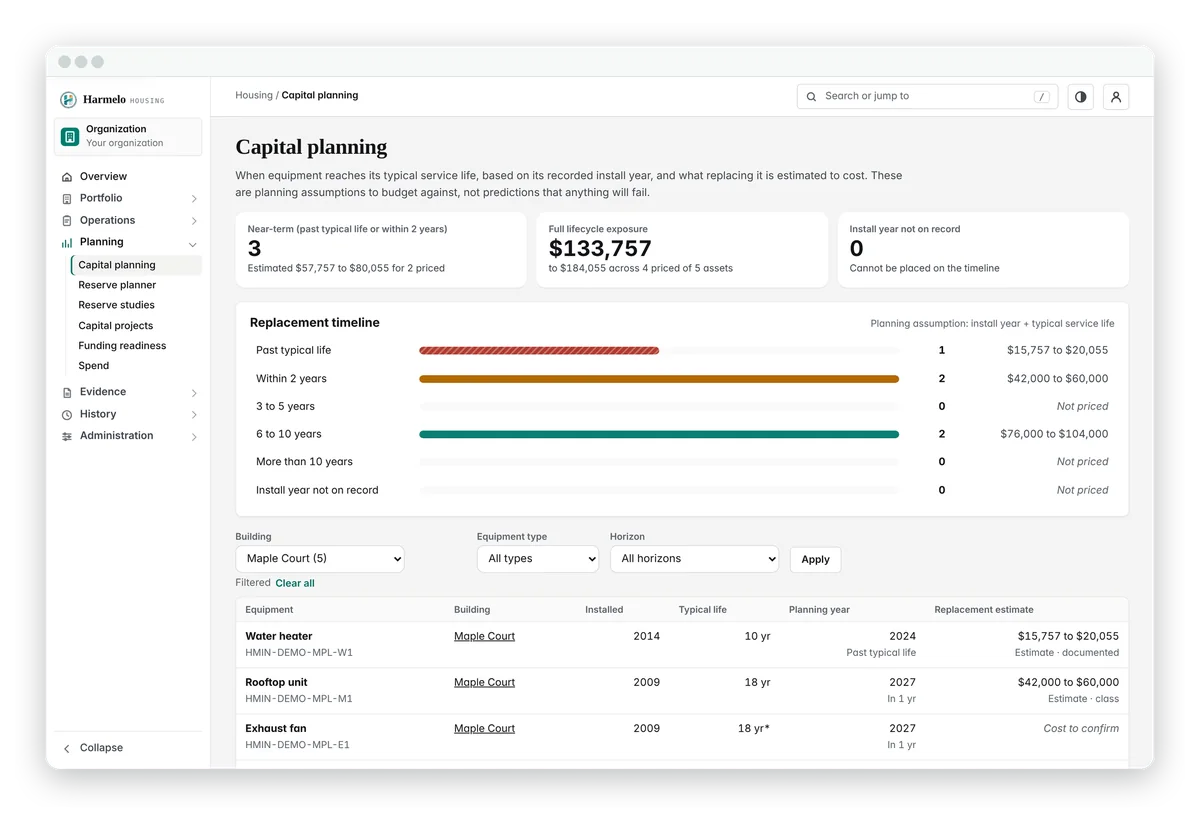
Why it matters: reserve studies, depreciation reports and capital plans start from the equipment actually on record, for review with qualified professionals.
Evidence outputs
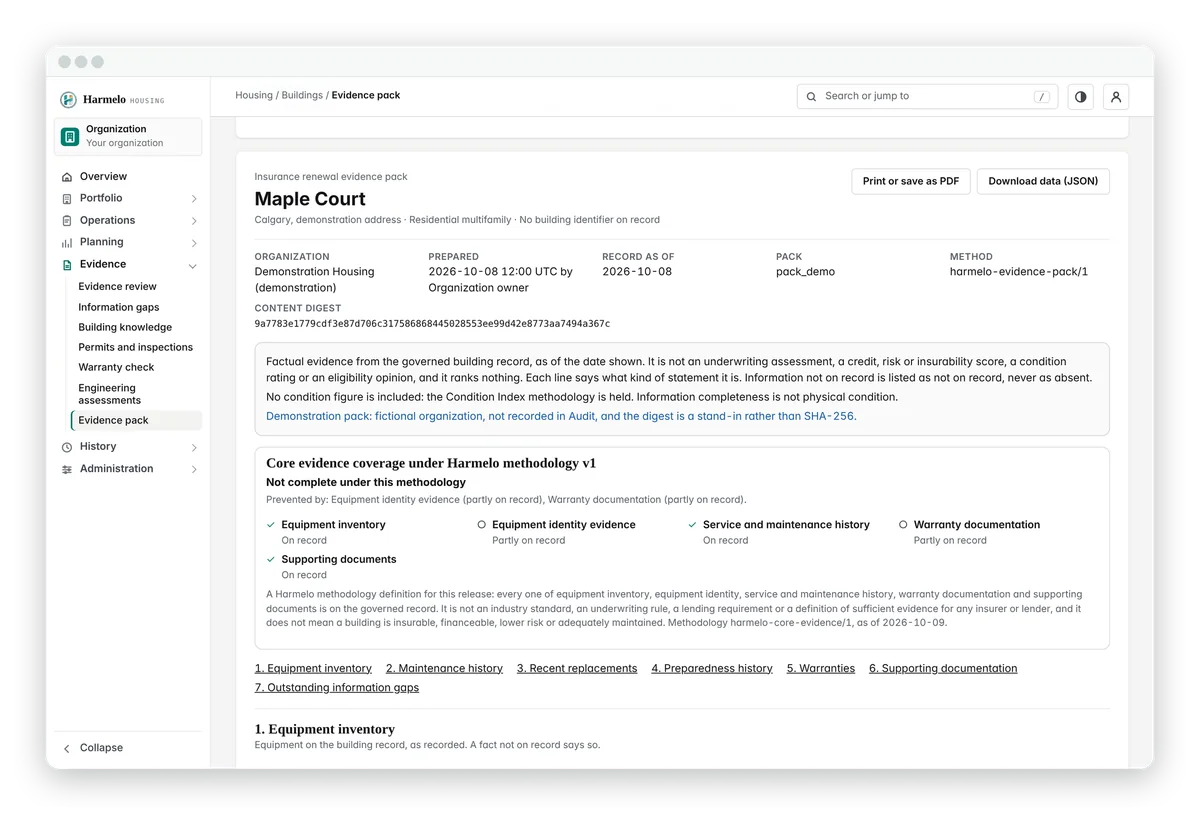
Why it matters: lenders, insurers and the next owner get facts with their sources, not a summary to take on trust.
Intelligence
Every building you are responsible for, on one screen
See what you own, what has been done to it and what is still open, across the portfolio. Each item carries its reason and the evidence behind it. Where there is not enough evidence, the record says so, rather than having gaps guessed at or quietly averaged in.
- What needs attention: safety observations, open recommendations, credentials and incomplete records.
- What may need funding: an estimated replacement window from documented age and service history, for capital planning and informed discussions with boards, lenders or funders.
- What the records show: repeat service, contractor changes and service patterns, from observed history.
Estimates should be reviewed alongside current inspections, professional advice and the organization's own planning requirements.
Who it is for
Everyone contributes. Everyone benefits. The history stays with the property.
Access follows role and permission. What an account can open is set by the organization that holds the record, not by the page.
Contractor
- The problem
- Technicians arrive without history, and good work is lost between visits.
- What changes
- Every visit is filed against the equipment, with readings, photos and recommendations kept together, and the office sees what each record still needs.
- Gets
- A customer history they did not have to reconstruct, and work that stays credited to them.
Owner or operator
- The problem
- Records scatter across contractors, spreadsheets and people who leave.
- What changes
- One record per building, with open items and gaps named across the portfolio. The owner decides who may add to it; property and facility managers approve access and follow open items across buildings.
- Gets
- A basis for decisions that outlasts staff and contractor changes, continuity through turnover, and an Infrastructure Disclosure Report when a building changes hands.
Housing provider
- The problem
- Between assessments, the history of each building lives in inboxes and memory.
- What changes
- Continuity across buildings, units, systems, contractors and staff.
- Gets
- Documented history for capital planning and future reserve or depreciation work.
Builder
- The problem
- Model, warranty and trade information is lost at handover.
- What changes
- The record starts at completion with equipment, trades, warranties and documents.
- Gets
- A more complete handover that the next owner and service provider can use.
Inspector
- The problem
- A report is read once and filed.
- What changes
- Inspectors and consultants contribute findings with identity and date attached, with observed, not observed and outside scope kept clear.
- Gets
- Work that stays useful after the inspection date and after the engagement ends.
Technology partner
- The problem
- Device data sits in a dashboard, apart from the equipment history.
- What changes
- Readings and events sit beside what is installed and what was serviced.
- Gets
- Context for its data while keeping its own customer relationship.
A record everyone can work from. Harmelo keeps service history connected to the building, so owners, contractors, tradespeople and portfolio teams can understand what happened, what changed and what needs attention next.
- Facts, not rankings. Harmelo preserves documented work. It does not rank contractors or sell preferred placement.
- Work that stays connected. Service notes and history remain attached to the equipment, creating continuity across visits, contractors and ownership changes.
- Clear boundaries. Harmelo does not certify work quality or promise leads. Participation does not give Harmelo ownership of a stakeholder's underlying information.
The outcome
Decisions that start from the record, not from a search.
Handovers that keep the history
When a building, a contractor or a manager changes, the record moves with the building. Handover review shows what moves and what is still missing.
Capital plans from the equipment on record
Replacement windows and reserve scenarios start from documented install dates, service history and cost ranges, for review with professionals.
Outputs a lender or insurer can read
Evidence packs and the Infrastructure Disclosure Report state each fact with its class and source, and say what is not on record.
Next step
Request a walkthrough, or discuss a pilot.
Tell us what you are responsible for. Someone from Harmelo will reply to arrange a virtual walkthrough of the workspace, the field app and the reports, using demonstration data, or to scope a pilot on a few of your buildings.
- No account is created and nothing is installed.
- Your details are used only to reply to this request.
- Running a service company? The contractor request asks about your crew and service area.