For owners and portfolio operators
Your next reserve study should not have to rediscover the last five years.
Every assessment, audit and acquisition starts with another round of data collection, because the history is spread across employees, vendors and software. Harmelo keeps a continuing asset and service record for every building you hold, so the next professional starts from what is already known.
A demonstration is a virtual walkthrough of the operator console using demonstration data.
- The problem
- The next reserve study rediscovers the last five years.
- What Harmelo does
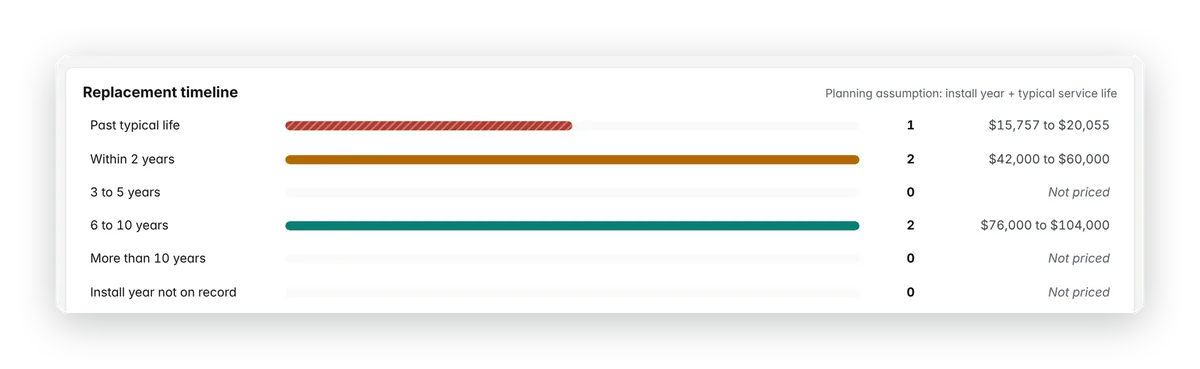
- A replacement timeline from documented install dates and typical service life.
- The outcome
- Capital timing you can plan around, for professional review.
What it costs today
You pay for the same building knowledge more than once.
Consultants spend billable hours confirming equipment, ages and past work that someone already documented.
Capital timing is set from install-year guesses when the service record is scattered or lost.
Documents arrive, but not a usable picture of what is installed, what was done and what is still open.
What an owner gets
From a record, to decisions you can defend.
The reserve study problem is where most owners feel it first. The same record answers far more.
From portfolio to equipment
One record, readable at every level you decide at.
Portfolio
Open items on recordNeeds attention
Property
Building system
Equipment record
- Installed and documentedIdentity, date and supporting evidence
- Service visit recordedWork completed, with contractor attribution
- Part replacedWhat changed and why
- Repeated observation surfacedHistory available for professional review
- Planning record updatedEvidence for the next reserve or capital decision
Portfolio signalsWhere attention, documentation gaps and upcoming planning needs sit across the portfolio.
What you receive
One continuing record per building, across the portfolio.
Each building shows what is on record and what is missing. Where there is not enough evidence, the record says so, rather than having gaps guessed at or quietly averaged in.
- Buildings, units, systems and major equipment in one view
- Service and replacement history tied to each asset
- Open recommendations and findings that repeat across visits
- Contractor and technician attribution on every record
- Warranty, permit, recall and supporting documents with the equipment
- Information that is still missing, named rather than hidden
- An acquisition baseline and an Infrastructure Disclosure Report
- Planning context between formal assessments
- The problem
- Acquisitions, renewals and refinancing each assemble the same evidence again.
- What Harmelo does
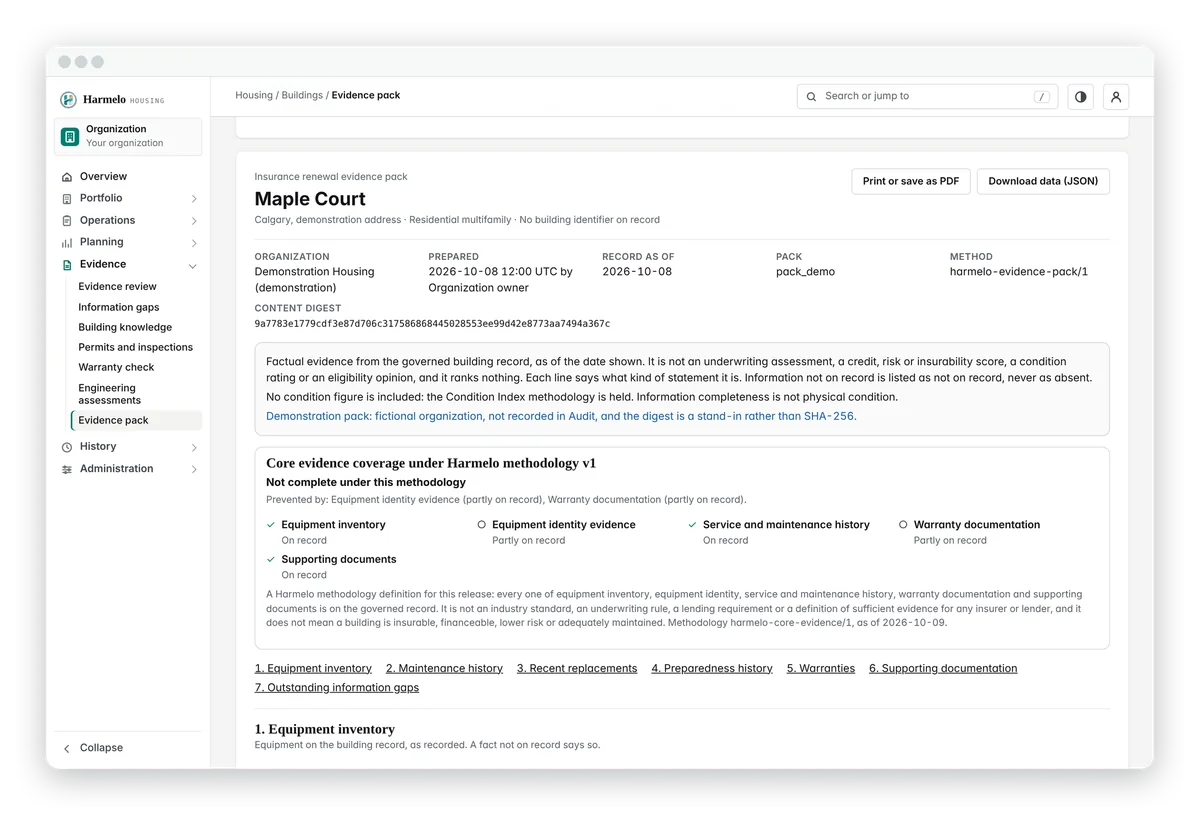
- An evidence pack from the record, each fact with its class and source.
- The outcome
- Diligence starts from documented facts, with gaps stated.
- The problem
- Every building's open items live in a different place.
- What Harmelo does
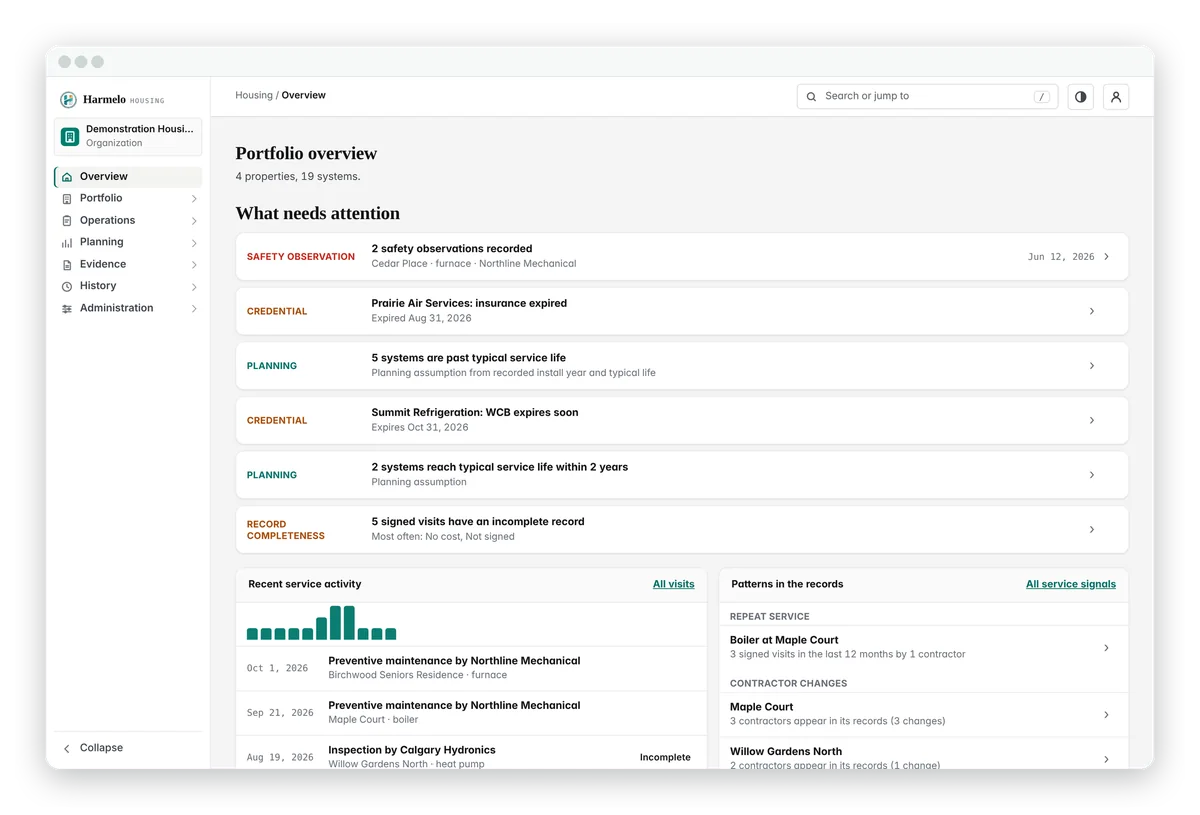
- One overview of what needs attention across the portfolio, each with its reason.
- The outcome
- Leadership acts on what is documented, building by building.
Contractor accountability
See who did the work, what they found and what they recommended.
- Every contractor you authorize files to the same standard
- Access is granted and revoked by you, building by building
- History stays with the building when a contractor changes
A signed record shows which identified account submitted it and connects that work to the asset. Harmelo does not independently certify a contractor's credentials, insurance or standing, and the workmanship itself is between the operator and the contractor.
- The problem
- Contractor work is invisible once the invoice is paid.
- What Harmelo does
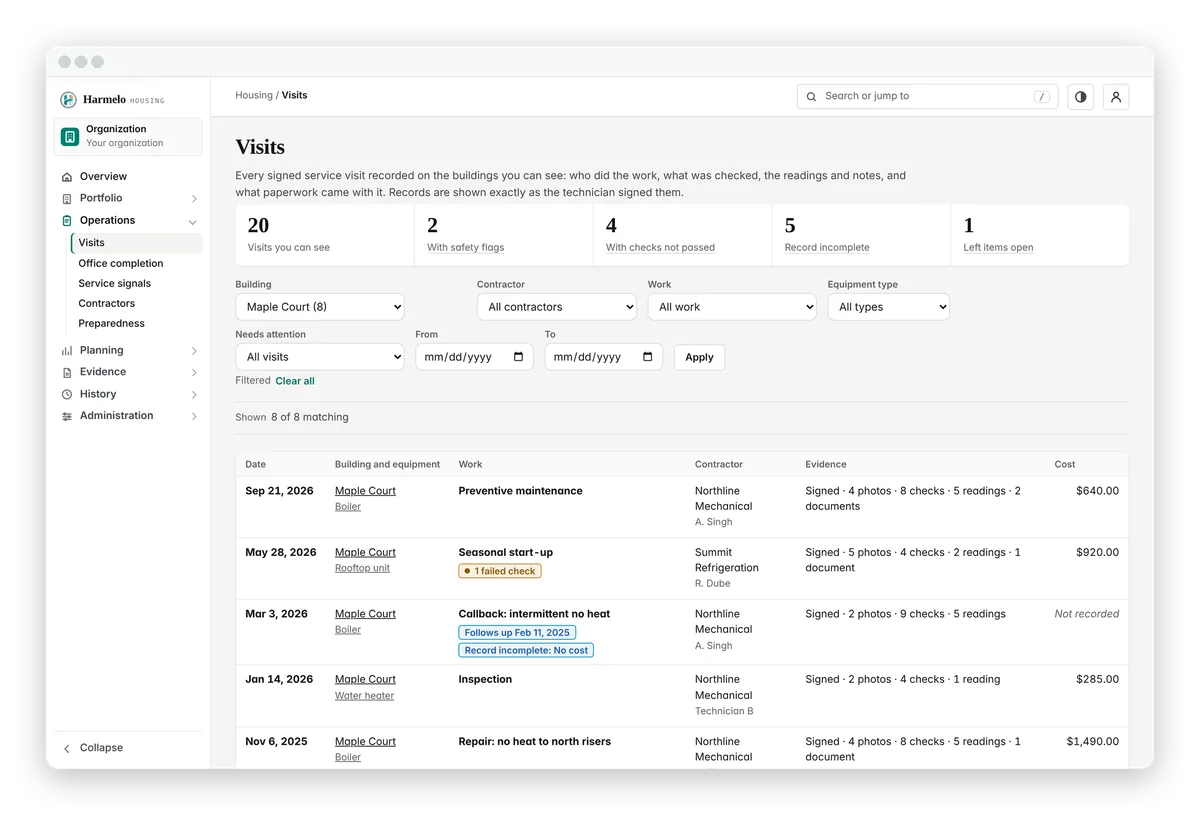
- Signed visits across every contractor, with findings and recommendations.
- The outcome
- You see who did the work, what they found and what they recommended.

Ask Elo
An assistant that works from your portfolio.
Harmelo organizational accounts include Elo, our assistant. Ask it why a system is flagged, what a fix involves, or what a replacement might cost as a planning range, and get a straight answer grounded in your own record instead of digging through it. Elo answers only from what your own account’s record shows, says plainly when the record does not say, and gives planning ranges rather than quotes, and points you to a qualified contractor for the work itself. Elo is available to signed-in accounts, with a daily question limit.
Alongside your systems
Pay professionals to assess the building, not to reconstruct its records.
Your property management system tracks leases and work orders. Your CMMS schedules tasks. Harmelo maintains a continuing asset and service record that can support your existing operational and planning workflows, and that survives when those systems, operators or owners change.
Harmelo does not replace a reserve study, depreciation report, engineering review or condition assessment. It preserves the information collected between those engagements so the next qualified professional starts with a clearer history.
Every month without a record adds to the history the next assessment will have to rebuild. What you capture now is what the next professional, owner or manager inherits.
Pricing
Published pricing for owners and operators
$60 per door annually, with a $5,000 annual minimum. Implementation and onboarding are priced separately.
The $5,000 is the minimum annual software commitment, not a flat fee. From 84 doors, the per-door figure is higher than the minimum and applies as calculated.
Door counts you give us are self-reported and used to prepare an initial estimate. Nothing is binding until Harmelo reviews it with you.
- $60
- per door, per year
- $5,000
- minimum annual software commitment
- Annual
- contract term
- Separate
- implementation and onboarding; pilots and custom integrations are scoped separately
Annual software commitment only. Implementation and onboarding are quoted separately.
Next step
Request a virtual walkthrough
Tell us about your portfolio. Someone from Harmelo will reply to arrange a virtual walkthrough of the operator console using demonstration data.
- No account is created and nothing is installed.
- Your details are used only to reply and prepare an initial estimate.
- Running a service company? The contractor request is the right form.