For public housing, civic and institutional portfolios
Public buildings outlast programs, contracts and careers. Their records should too.
Staff retire, programs end and service contracts change hands. Harmelo keeps a continuing record of each building’s equipment, maintenance, contractors and documents, so the people responsible next inherit what was known, what was done and what is still open.
A demonstration is a virtual walkthrough using demonstration data. Nothing is installed.
The problem
Public infrastructure runs for decades. Its records can become fragmented through a single reorganization.
Funders ask what the money bought. Auditors ask for the basis of a plan. Too often the answer is rebuilt at public cost.
Decades of building knowledge leave when a long-serving manager does.
Each service provider and program kept its own files, in its own format.
Condition and inventory information is collected again because nobody can find the last collection.
What changes
Continuity, evidence and accountability for public buildings.
What you receive
Evidence that survives the next reorganization.
- Continuity through staff, contractor and program changes
- Traceable records of who completed work and what they provided
- Consistent information across housing, civic and institutional buildings
- Documentation gaps identified before funding or capital decisions
- A building record that transfers between departments and service providers
- Supporting evidence for planners, engineers, councils, boards and funders
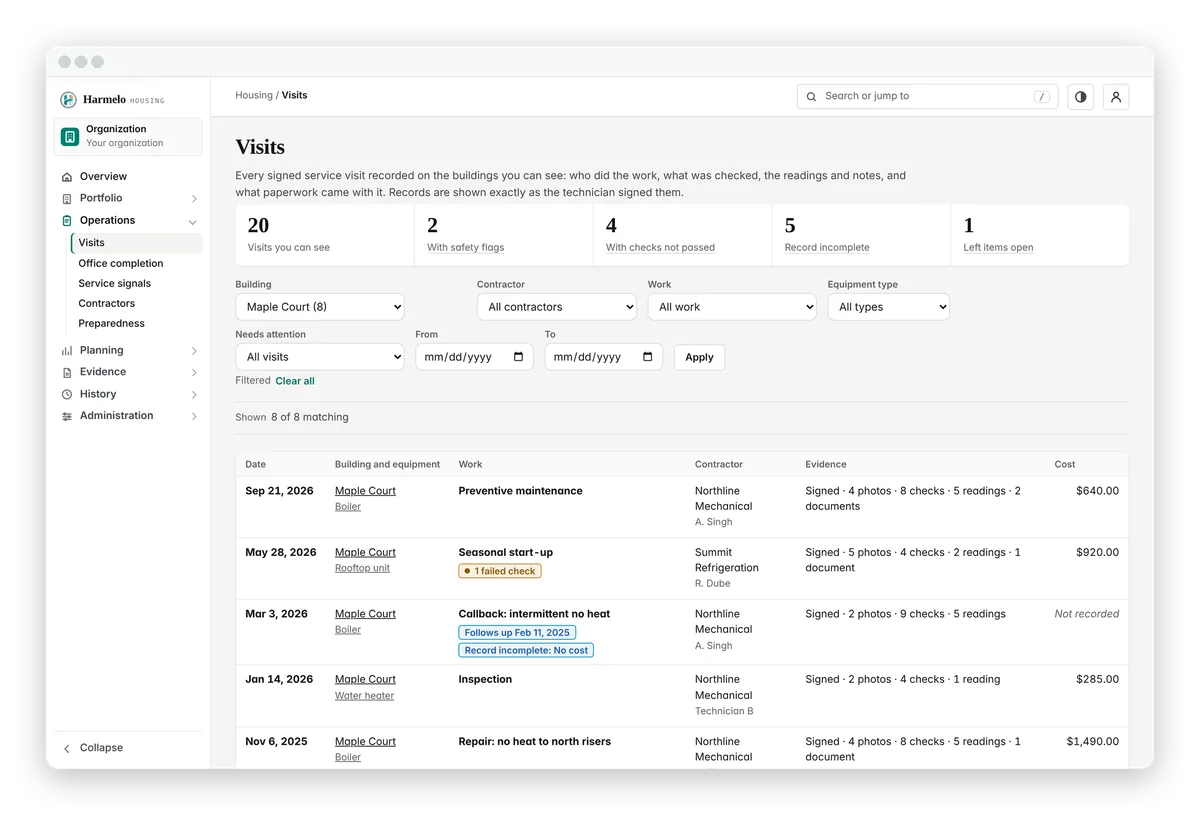
- The problem
- Public money is spent on buildings with little record of what was done.
- What Harmelo does
- Signed visits across every contractor, kept with each building.
- The outcome
- Work funded is work documented, through every contract change.
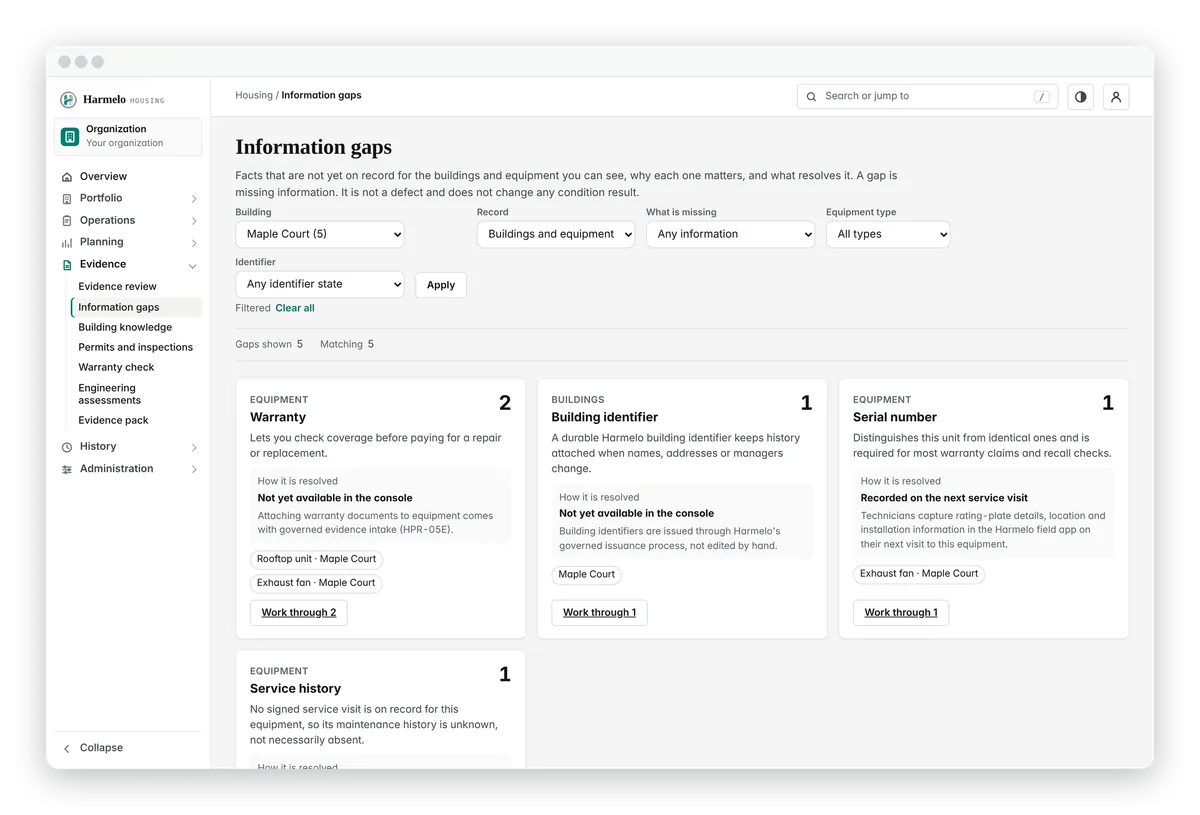
- The problem
- Funding decisions depend on records nobody has checked.
- What Harmelo does
- Documentation gaps counted per building, each with how it is resolved.
- The outcome
- Gaps are closed before money is committed.
How it works
Continuity by design, not by memory.
- Set up from what existsExisting documents are organized per building, and missing information is listed.
- Service providers file to one standardWhoever holds the contract records work against the right equipment.
- Hand over between teamsA department, operator or provider change moves the record, not a box of files.
- Decide with the gaps in viewCapital and funding conversations start from what is documented and what is not.
Do not spend public dollars rediscovering information the portfolio once held. Knowledge that is not recorded before the next change has to be rebuilt after it.
Scope
What Harmelo is, and is not.
Harmelo is the continuing record of buildings, equipment and the work done on them. It works alongside your maintenance and asset systems.
Not an inspection
Harmelo does not perform, certify or substitute for any regulated inspection or code compliance review.
Not certification
A signed record shows which identified account submitted it and connects that work to the asset. Harmelo does not independently certify a contractor's credentials, insurance or standing, and the workmanship itself is between the operator and the contractor.
Not an endorsement
Nothing here implies a government endorsement, a procurement decision, compliance certification or an automated engineering decision.
Next step
Request a virtual walkthrough
Tell us about the portfolio. Someone from Harmelo will reply to arrange a virtual walkthrough using demonstration data. Engagements are scoped per portfolio.
- No account is created and nothing is installed.
- Your details are used only to reply to this request.
- No pricing is discussed on this page, and nothing here implies a procurement decision or an endorsement.